
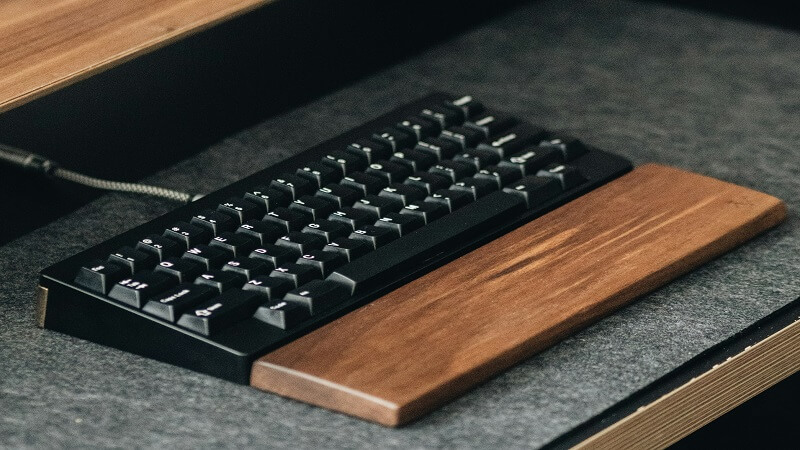
A desk can look tidy and still feel loud. You sit down, open a project, and within minutes the surface starts to fill up with “just for now” items. Notes, a keyboard nudged a little sideways, a charger that never stays where you expect, a monitor base that somehow takes more room than it should. A desk shelf changes that story in a way that feels almost unfairly simple. You add height, and suddenly you’re not fighting for space on a single plane anymore. In the Oakywood desk shelf collection, the idea is not to decorate your desk or turn it into a display. It’s to make the workspace behave better, with a raised layer that creates order by default. The best part is how quietly it happens. You don’t need a new routine or a complex system. Your monitors move up, your hands get a clearer zone, and the space under the shelf stops being wasted. It becomes a low-profile “keep it close, keep it clean” area that helps the whole desk feel intentional again.
Why desk shelf feels like a reset
There’s a specific kind of relief that comes from seeing a clear center space on your desk. It’s not about minimalism as a look. It’s about not having to negotiate with your own setup every time you start a task. A desk shelf creates that reset effect because it separates what you need to see from what you need to use.
Monitors belong higher, closer to your natural line of sight, and that single decision immediately frees the desk surface from visual weight. The desk stops feeling like a crowded countertop and starts feeling like a work area again. In the Oakywood collection, the desk shelf is described as a way to raise your screen to eye level and create extra space underneath, and those two moves tend to solve more problems than people expect.
You also get a different kind of “reset” at the end of the day. When the main surface is less cluttered, cleaning up doesn’t turn into a whole project. You put a few items back, slide what you want under the shelf, and the desk looks ready for tomorrow without drama.
Natural eye line
It’s easy to underestimate what screen height does to the feel of a workstation. A desk shelf lifts the display into a calmer viewing position, so your head and neck aren’t subtly negotiating with the monitor all day. Oakywood highlights the idea of raising the screen to eye level, and that’s exactly the kind of change that doesn’t look dramatic in a photo but feels obvious once you work with it.
The difference shows up in small moments. You glance at a reference, you return to your notes, you jump back to the screen. When the monitor sits higher, those transitions feel smoother. Your shoulders tend to settle. Your gaze doesn’t drop into the desk surface as often. The desk shelf becomes less of an “accessory” and more of a quiet alignment tool.
Under-shelf space that stays usable
A common problem with desk organization is that storage solutions often create new friction. A drawer that blocks your knees, a tray that eats the very space it’s supposed to save, a stackable box that turns into a pile. A desk shelf avoids that because it doesn’t claim the center of the desk, it lifts part of the setup upward and leaves a usable zone below. Oakywood points out that the shelf adds extra space underneath, and that area is where the desk starts feeling calmer.
What goes under the shelf depends on how you work. Some people keep it simple, a keyboard when they need a clean surface, a notebook that stays within reach, headphones when a call ends. Others treat it like a “quiet staging area” for items they don’t want scattered on the desk. The shelf doesn’t force a strict method, which is exactly why it works across different routines.
Desk shelf strength that supports real setups
A raised layer only makes sense if it’s stable. If it wobbles, creaks, or feels uncertain, your brain never fully trusts the setup. The Oakywood Desk Shelf is presented as strong enough to hold substantial weight, with the product page noting a maximum load of up to 100 kg and positioning it as suitable for two monitors or one wide display. That kind of capacity matters because it means the shelf isn’t a delicate riser you baby all day. It’s meant for a real workstation with real gear.
This also changes how you use the desk. You stop thinking about whether the shelf can handle your setup and start using it as a stable platform. That mental “click” is part of what makes the desk feel quieter.
Oakywood collection logic without overexplaining
When a collection is built around a desk shelf, it usually means the brand is thinking in systems, not single items. The Oakywood desk shelf collection includes the idea of compatible modular drawers designed to make the desk shelf even more functional. The collection description mentions steel bases in two sizes, four types of modules, and three color versions, which signals something important. You’re not locked into one arrangement. You can build an under-shelf setup that matches how you actually use the desk.
The key is that the shelf remains the anchor. It creates the second level, and everything else becomes optional support. That’s a smarter approach than buying random organizers and hoping they cooperate.
Desk shelf and modular drawers as quiet structure
A desk shelf already creates a new layer. Adding modular drawers under that layer can turn “extra space” into “useful space” without adding visual noise. The Oakywood collection frames these drawers as compatible additions that can be combined in different ways, and that flexibility is the point.
Think of it less like stuffing more storage onto the desk, and more like shaping what happens under the shelf. If you like a clean surface, drawers let you keep small items out of sight without moving them far away. If your work involves switching between tools, the drawers can become a stable home base for the things you reach for constantly. The result is not a desk that looks “organized” for a photo. It’s a desk that stays workable in the middle of a busy week.
How desk shelf changes the way clutter happens
Clutter rarely arrives all at once. It creeps in. A cable you’ll deal with later, a sticky note that turns into five sticky notes, a device that needs charging, a pen that doesn’t return to its cup. A desk shelf changes that pattern because it gives your setup a clearer hierarchy.
Top level for screens and the items that belong near them. Main surface for hands and active work. Under-shelf zone for the things you need nearby but don’t want in your face. That hierarchy is simple, but it’s powerful. It reduces the chance that everything ends up everywhere.
Over time, the shelf can teach your desk a habit. Not your brain, your desk. When there’s an obvious “home” for categories of items, the surface stops becoming a catch-all. It’s easier to put things away because “away” still means “right here, just not on the main plane.”
Desk shelf for single-focus and multi-task desks
Some desks are built for one thing, one screen, one task. Others carry a whole day’s worth of roles, work, study, side projects, planning, calls. A desk shelf works in both cases because it supports focus without demanding simplicity.
On a single-focus setup, the shelf can make the desk feel cleaner and more comfortable, with screens raised and the main surface open. On a multi-task setup, the shelf becomes the anchor that keeps everything from spreading. When you switch from typing to sketching to reading to a call, the desk shelf helps the workstation stay stable instead of turning into a constantly shifting pile.
Oakywood positions the desk shelf as ideal for two monitors or one wide display, which fits both work styles. It can support a straightforward setup, or it can help a complex setup feel calmer.
Desk shelf as a long-term, low-drama upgrade
Some upgrades feel exciting for a week and then disappear into the background. A desk shelf is different because its impact shows up in daily micro-moments. You sit down and your hands have room. You look up and the screen is where you want it. You finish a task and the desk doesn’t look like a storm passed through it.
That’s also why the desk shelf fits the Oakywood philosophy of a workspace built around structure and materials that age well. The collection text emphasizes modularity and the ability to build a personalized arrangement under the shelf, which suggests a product ecosystem meant to adapt as your needs shift.
A desk shelf does not ask you to “optimize” yourself. It simply offers a calmer desk geometry. The kind you notice every day, mostly because you stop noticing problems you used to accept as normal.